Data loss prevention in the age of AI
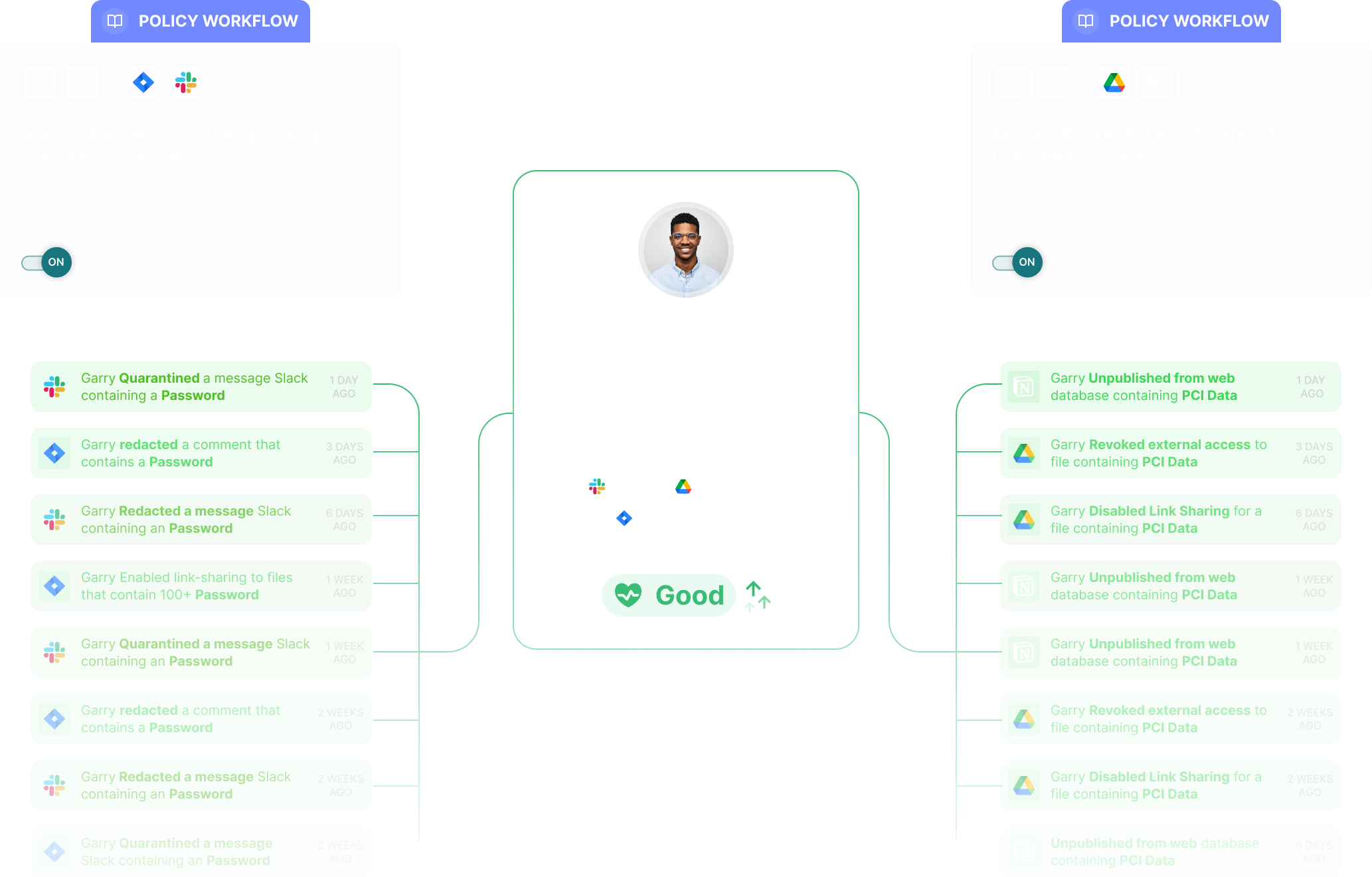
Metomic spent years classifying sensitive data across your SaaS apps. That engine now works wherever your people and their agents use AI.
Trusted by SaaS enabled teams










%20logo.svg)











.png)


From SaaS data loss prevention to AI data security
For years Metomic found sensitive data in your SaaS apps and gave your team a way to fix it. Now it works in the path of your AI agents and in the browser, where your people use AI directly.

Discovery
See which AI tools your people use and every request your agents make, from day one.

Approvals
Coach, allow, block, or hold a risky request while a person approves or denies it.

Evidence for auditors
A record of every agent action and a clear view of how your AI behaves, ready for the auditor.

Connect the SaaS apps your AI agents reach through Metomic
Set up a connector once in Metomic and every AI tool you use gets the same access, with nothing to install.








.png)
.png)
.png)
.svg)
.png)
.png)
.png)


What our customers are saying about Metomic
Use keyboard
to navigate through testimonials
Metomic provides an excellent, easy-to-navigate interface with the necessary features to help keep our workspace secure.
.png)
We use Metomic to uncover sensitive company data and prevent it from being shared or residing in places it shouldn't. It's a really great supplement where technical controls that could be our frontline of defense don't exist.

Easy integration. It is as simple as a few clicks (and the Metomic onboarding process is excellent, too, as the team guides us through the process).


Metomic addresses risks efficiently—blocking unsafe data sharing or sending alerts to users. This allows our team to remain productive while keeping our data secure. The visibility and control Metomic provides has been game-changing in helping us implement a solid, proactive approach to data security.


The machine learning aspect of AI means that, when paired with security solutions such as identity verification and biometric authentication (voice or fingerprint), it improves in its detection over time, increasing accuracy but also reducing the number of false positives.


I appreciate how configurable and easy it is to setup alerting workflows. The tool is lightweight and easy to integrate into the platforms that our company uses. The customer support team has been excellent at addressing all of our company's concerns.

The big thing for me was how interactive it was in Slack. That was one of our biggest problem points and there was a solution for that immediately.

Immediately, especially for the Google Workspace document sharing, Metomic has paid for itself seven fold.


We were able to find some legacy AWS keys from years ago...that gave us the confidence that in the event of new secrets appearing insecurely across our tech stack, we could rely on Metomic to help us swiftly detect and respond in a click of a button.


Metomic is a SaaS enabler. They help us protect sensitive data in applications like Google Drive, so we can grow our business knowing our data is safe.

Having real-time data-driven insights to share with stakeholders has been invaluable. Metomic ensures that we’re compliant, secure, and proactive, providing the operational resilience necessary to grow in a competitive digital commerce market.
Questions before the rollout.
What is DLP?
Data Loss Prevention (DLP) is the set of tools, techniques, and people that keep sensitive data from being leaked, stolen, or lost. It covers data on-premises and in the cloud, at rest and in transit, and it works by comparing what is happening in your business against the rules you set.
A DLP strategy tells you where sensitive data lives, who can reach it, and how large your exposure is. That was the job for years, and it is still worth doing. The question has grown since: which AI tools your people use, which agents reach your data, and what those agents do once they get there.
Why is DLP software important for businesses?
Businesses run sensitive data through more places than one team can watch, and the reasons to control it stack up:
- Customer records and your people's personal data are among the most valuable things you hold, and among the easiest to lose. One over-shared link is usually all it takes. Protecting them keeps the people who trust you out of harm's way, and keeps you out of an incident report.
- Compliance with regulations such as GDPR, HIPAA, and CCPA is hard when you cannot say where your data lives. Data discovery, sharing limits, and retention periods give you an answer you can evidence rather than assert, which is what an auditor or an enterprise buyer asks for.
- Trade secrets leak the same way personal data does, through a shared link or a pasted document. Source code, pricing models, and unannounced plans are exactly the material that ends up in the wrong window, and a competitor gets your thinking for free.
- Breaches cost money, time, and reputation. Holding less data and finding exposure early shrinks the surface an attacker can reach, the fine that follows, and the number of customers who ask you to explain yourself.
What are the types of DLP?
Data loss prevention is usually split by where the data sits, and most security teams end up running more than one type:
- Cloud DLP: Protects data held in cloud applications such as Microsoft 365, Google Workspace, and AWS. Your security team sees who can reach data in cloud environments, and can encrypt it for another layer of protection.
- SaaS DLP: A subset of cloud DLP, SaaS DLP covers data held in apps such as Slack, Google Drive, Microsoft Teams, and more. It detects sensitive data and shows you where it sits across files, assets, and chats, including the shared links and channels nobody has looked at in two years.
- Network DLP: Controls data as it moves across the network, including email and cloud traffic. It blocks unauthorized uploads and shows your security team where sensitive data lives and who can reach it.
- Endpoint DLP: Installed on laptops and phones, endpoint DLP watches where data is stored and whether it has moved. It classifies sensitive data so the right protection policies apply to the right files, and it is the type most organizations push back on, because it means another agent on the device.
How does DLP work?
DLP works by comparing the rules you set against what is happening across your organization.
Say you have decided that credit card numbers do not belong in cloud storage. The software scans the content held in your cloud apps, finds the card numbers, and weighs the context they sit in against that rule before it does anything about them. Context is the part that matters, because the same string of digits is fine in one place and a problem in another.
Metomic shipped classifiers for email addresses, phone numbers, social security numbers, and more, plus custom classifiers for the data types specific to your business. That classification engine still does the work. It now runs on prompts and agent requests as well as files.
Once a rule is broken, what happens next is yours to set: alert your security team, coach the person involved, redact the sensitive part, block the action, or hold it while someone approves or denies. Metomic scans content in flight and does not store the source content.
Metomic also goes to the person, or to the agent's owner, in Slack or Teams, so the fix happens where the work happens rather than in a ticket queue nobody reads. Most exposure gets cleaned up by the person who created it, within minutes, without your team touching it.
All of it leaves a record. Your security team gets the reports and audit logs to investigate an incident, keep compliance records, and hand something concrete to an auditor.
What are the benefits of Data Loss Prevention software?
Data ends up in the wrong place in most companies. Most hold more of it than any one person or team can track, so exposure builds quietly until something surfaces it, and by then the data has usually been somewhere it should not have been for months. Manual review does not scale to that, and neither does a written policy people agree to once at onboarding.
DLP software is worth the investment if you want to:
- Protect sensitive data and cut your risk of a breach or a leak
- Evidence compliance with regulations like GDPR, HIPAA, and CCPA
- Keep intellectual property and trade secrets inside the business
- Win customer trust by showing how you handle their data
- Shrink your attack surface by holding less data in the first place
- Enforce your security policy instead of publishing it and hoping
- Spot insider threats and unusual behavior before they become incidents
- Teach your team good habits without running a training program
Why is Metomic moving from DLP to AI data security?
Metomic built its business classifying and protecting sensitive data in SaaS apps: Slack, Google Drive, Jira, Microsoft 365, and more. That held while the risk was a person sharing a file with the wrong audience.
Then the risk moved. Your people paste customer records into chat tools on personal accounts, and your agents inherit the permissions their owner holds. Metomic is the AI data security layer for everything your people and their agents do with sensitive data. It sits in the path of your agents, and in the browser where your people use AI directly.
Book a personalized demo and we will show you what is already happening in your environment.
Book a demo
Our team of security experts are on hand to walk you through the platform and show you the impact it can have on your business.
Simply fill in the form and we'll get back to you as soon as we can.


_BestEstimatedROI_Mid-Market_Roi.png)
_HighPerformer_HighPerformer.png)