Compliance you can prove
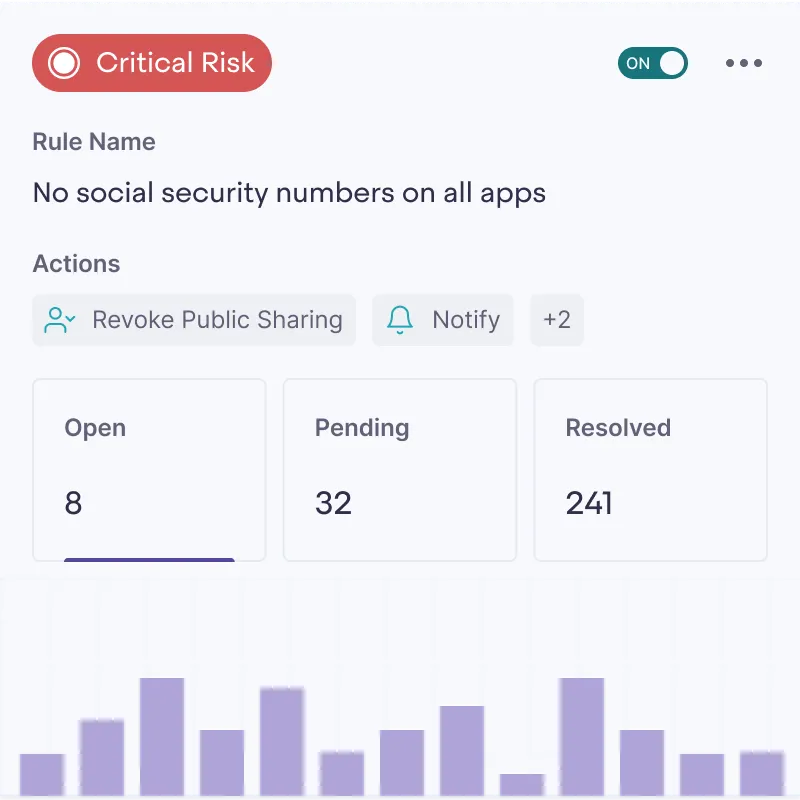
For years, Metomic found and protected the sensitive data sitting in your SaaS apps. Auditors now ask a harder question: what your AI touched, and who approved it. Metomic answers that one.
Trusted by SaaS enabled teams










%20logo.svg)












.png)


HIPAA, PCI and GDPR now include your AI
Metomic scans what your people and their agents send to AI, holds or blocks the requests carrying regulated data, and keeps the record your auditor asks for. Your team keeps working.
HIPAA
Metomic keeps patient records out of AI tools and agent requests that should not see them.
PCI
Metomic redacts or holds cardholder data before an agent carries it onward.
GDPR
Metomic records the personal data your agents touch, so minimization holds and you can answer a subject request.

Your agents reach these SaaS apps through Metomic
Set up Slack, Google Drive, Notion and more once in Metomic. Your agents then reach them under your rules.







.png)
.png)
.png)
.svg)
.png)
.png)
.png)


What our customers are saying about Metomic
Use keyboard
to navigate through testimonials
Metomic provides an excellent, easy-to-navigate interface with the necessary features to help keep our workspace secure.
.png)
We use Metomic to uncover sensitive company data and prevent it from being shared or residing in places it shouldn't. It's a really great supplement where technical controls that could be our frontline of defense don't exist.

Easy integration. It is as simple as a few clicks (and the Metomic onboarding process is excellent, too, as the team guides us through the process).

Metomic addresses risks efficiently—blocking unsafe data sharing or sending alerts to users. This allows our team to remain productive while keeping our data secure. The visibility and control Metomic provides has been game-changing in helping us implement a solid, proactive approach to data security.


The machine learning aspect of AI means that, when paired with security solutions such as identity verification and biometric authentication (voice or fingerprint), it improves in its detection over time, increasing accuracy but also reducing the number of false positives.


I appreciate how configurable and easy it is to setup alerting workflows. The tool is lightweight and easy to integrate into the platforms that our company uses. The customer support team has been excellent at addressing all of our company's concerns.

The big thing for me was how interactive it was in Slack. That was one of our biggest problem points and there was a solution for that immediately.

Immediately, especially for the Google Workspace document sharing, Metomic has paid for itself seven fold.


We were able to find some legacy AWS keys from years ago...that gave us the confidence that in the event of new secrets appearing insecurely across our tech stack, we could rely on Metomic to help us swiftly detect and respond in a click of a button.


Metomic is a SaaS enabler. They help us protect sensitive data in applications like Google Drive, so we can grow our business knowing our data is safe.

Having real-time data-driven insights to share with stakeholders has been invaluable. Metomic ensures that we’re compliant, secure, and proactive, providing the operational resilience necessary to grow in a competitive digital commerce market.
Questions before the rollout.
What is SaaS compliance software?
SaaS compliance software helps you meet standards like HIPAA, PCI DSS and GDPR inside the tools your team works in every day. A SaaS provider covers its own platform. What your people put into it stays your responsibility.
Metomic spent years on that job: finding regulated data across SaaS apps, cutting what you kept longer than you needed, and giving security teams a clear view of where it sat. That work is the foundation for what the platform does now.
The compliance question has moved. Your team pastes customer records into AI tools, and their agents reach the same SaaS apps through connectors nobody reviewed. The old question was which app held your regulated data. The new one is what your AI did with it, and whether you can show that. Metomic sits in both paths, scans what moves, and keeps the record.
What are some common SaaS compliance standards?
Data held in SaaS applications still has to meet the same requirements. The General Data Protection Regulation (GDPR) covers the data protection rights of EU citizens and shapes how most organizations handle personal data.
Under GDPR you obtain explicit consent for processing, set retention periods, minimize what you keep, keep records accurate, and tell the Information Commissioner's Office (ICO) about a breach within 72 hours.
ISO 27001 applies across many industries and focuses on information security management: risk assessments, security policies, access controls and continuous monitoring. Auditors now ask how those controls hold up when an AI agent is the one touching the data.
Service Organization Control 2, known as SOC 2, applies to cloud and technology companies and covers security, confidentiality and processing integrity. Metomic holds SOC 2 Type II. ISO 42001 covers AI management systems, and the EU AI Act sets requirements for AI systems used in the EU. Both ask you to show how AI behaves in practice, which is a record-keeping problem before it is a policy problem.
What compliance regulations should specific industries be paying attention to?
Regulations differ by sector, so the list you work to depends on the data you handle. A few examples of industry-specific compliance laws:
- Healthcare
Organizations handling patient data in the United States work to the Health Insurance Portability and Accountability Act (HIPAA), which sets strict rules for protecting Patient Health Information (PHI) and securing how it moves between organizations. Those rules hold when a clinician pastes case notes into an AI assistant. - Financial Services
Finance teams work to several financial compliance regulations, including the Gramm-Leach-Bliley Act (GLBA), which protects non-public personal information (NPI) and requires a written security program. Companies processing payment cards also work to the Payment Card Industry Data Security Standard (PCI DSS), which keeps cardholder data secured through encryption and other controls. Agent traffic carrying that data falls inside the same scope. - Educational Institutions
Schools and other educational services in the US comply with the Family Educational Rights and Privacy Act (FERPA), which protects student education records and gives parents access to their files.
How does AI change compliance in SaaS applications?
Your team uses AI tools nobody approved, often on personal accounts that sit outside the corporate tenant. Their agents reach your SaaS apps through connectors, at a volume no manual review process was built for.
Most teams have a policy for this. It sits in a PDF, and nothing technical stops a risky request from going through. Visibility on its own runs into the same wall: you can see the exposure and have no lever to pull.
Metomic shows you which AI tools your team uses and how heavily, what each vendor's own terms say about training on your data, and every request an agent makes, including who asked and what data it touched. That feed goes into your SIEM alongside the rest of your telemetry.
None of this needs an endpoint agent, and it needs no API integration with each AI vendor. Metomic works in the browser and in the path of the agent, which matters when your people work in a tenant you do not control.
From there you decide what happens: coach the person, allow the request, block it, or hold it while someone approves. Each decision leaves a record, which is the part an auditor asks for.
Benefits of SaaS compliance software for an organisation
SaaS compliance software cuts the data you hold, shows you where regulated data sits, and turns an audit into a shorter conversation. It also reduces the chance of a fine, and gives customers a straight answer when they ask how you handle their data.
Applied to industry-specific standards such as GDPR, HIPAA or PCI DSS, it keeps the way you work aligned with what those standards require, rather than leaving the gap between the policy document and daily practice open. It also gives you something to take into a budget conversation, instead of an argument about spending on prevention.
With AI in the picture, the benefit sharpens. You see which tools your team uses and what agents touch, and you get that on day one, before anyone writes a policy. The platform separates a passing visit to an AI site from sustained use, so your team reviews signal instead of a long list of domains.
Reporting turns into evidence: the record of what your AI did and which requests a person approved, ready to hand over. Your team spends its time on the requests that matter, and the business keeps saying yes to AI.
Why choose Metomic to help you remain compliant?
Metomic has classified and protected sensitive data in SaaS applications since 2018, which is where the platform's understanding of your data comes from. Most tools do one half of this job, classifying data at rest or watching an agent's traffic. Metomic does both.
That combination is what makes the record useful. Metomic knows what the data is, sits in the path of the request, and logs the decision, so your evidence describes what happened rather than what your policy intended.
You get visibility on the first day, hosted and preconfigured, with no endpoint agent to roll out and nothing your team has to notice. It works across the agents, apps and MCP tools you have already adopted, whoever built them.
Then the controls: coach, allow, block, or hold a request for a person to approve. Your auditor gets a record of every agent action and a clear view of how your AI behaves.
Compliance you can prove.
Book a demo
Our team of security experts are on hand to walk you through the platform and show you the impact it can have on your business.
Simply fill in the form and we'll get back to you as soon as we can.


_BestEstimatedROI_Mid-Market_Roi.png)
_HighPerformer_HighPerformer.png)