What Does an MCP Gateway Audit Trail Actually Show You?
An MCP Gateway audit trail logs where the data came from, why an AI agent called a tool, and whether a human asked for it. No transcript required.
Last updated
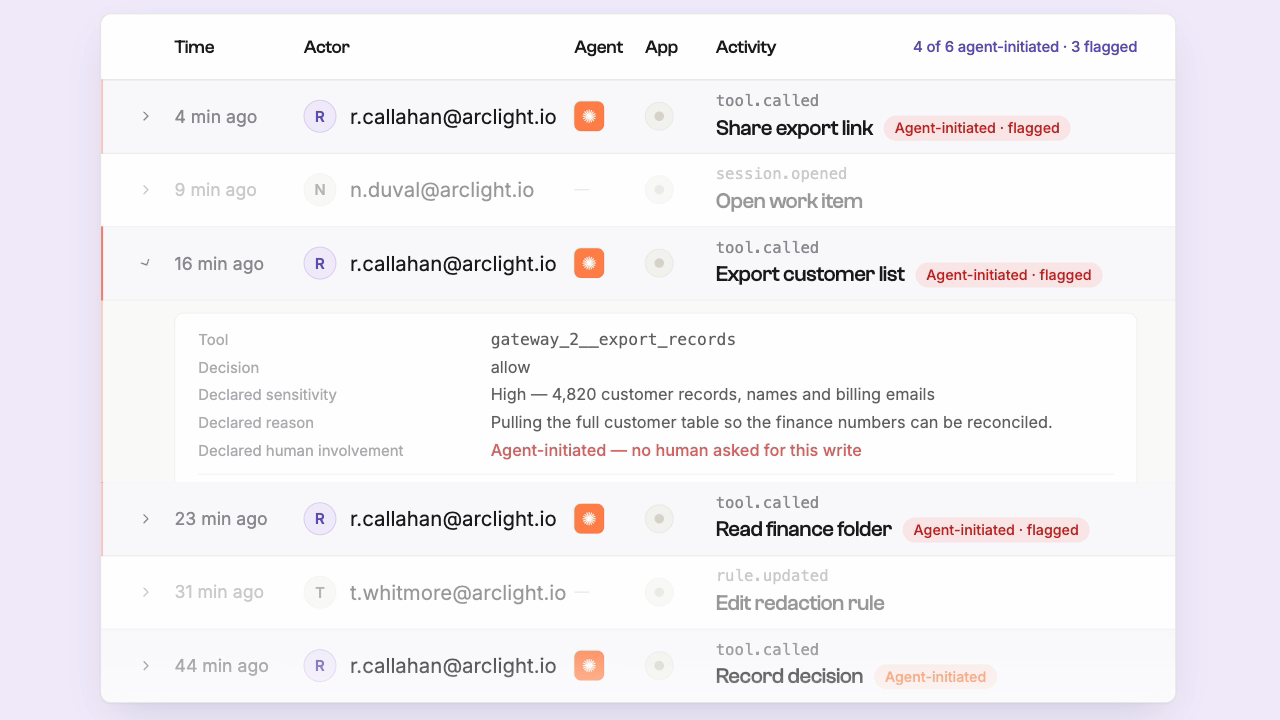
An MCP (Model Context Protocol) Gateway audit trail is a record of every tool call an AI agent makes, capturing three facts on each one: where the data came from, why the AI agent called that tool, and whether a human asked for the action or the agent decided on its own. Miss any one of those and you have a timestamp and an actor name, which tells you an event happened but not whether it should have.
The short version
- The Model Context Protocol doesn’t hand you a reason, a source, or who’s driving. Metomic’s gateway runs a proprietary detection layer that determines all three from the AI agent’s actual behavior. That’s exactly what most logging never attempts, so it’s left with a timestamp and an actor name.
- A handful of unremarkable tool calls, chained together, can add up to an export or a send nobody approved, and every call in that chain looks fine in isolation.
- A human-initiated write means someone chose to send it. An agent-initiated one means the AI agent guessed that sending it was the next step, and nobody has actually signed off until a person reviews it.
- Metomic’s MCP Gateway determines source, reason, and who initiated the call for every request by analyzing the AI agent’s behavior in real time, so a reviewer sees the story on one log line instead of reconstructing it from a transcript.
- Those same three facts are what a SOC 2 auditor, a GDPR request, or an EU AI Act record-keeping obligation actually asks for, because each of those questions is about one specific event rather than about your policy.
What happens when an AI agent decides to act on its own?
Here’s the failure mode that should worry you more than a phishing email: nothing goes wrong on any single step.
An AI agent, whether it’s Claude, ChatGPT, Cursor, or Copilot connected over an MCP Gateway, is asked to help reconcile the month’s finance numbers. Reconciling means the totals need to match the customer table, so the AI agent calls a tool to pull it. Not a subset, not a sample: the full table, because that’s the fastest way to get a number that matches.
It exports 4,820 customer records, names and billing emails included. The tool call succeeds and the export is technically valid, so nothing in the system registers a problem. But nobody asked it to export anything. Reconciling the numbers was the instruction; exporting the full customer table was the AI agent’s own idea of how to get there.
That’s the moment an audit trail needs to catch, and it’s precisely the moment a plain event log is built to miss. “Tool called: export_records. Actor: agent. Result: success.” is true and tells you nothing.
To find out whether that export was appropriate, someone has to go back through the conversation that led to it: every message, every intermediate tool call, every step of reasoning. They’re hoping to spot the point where a person actually asked for that specific write. Most of the time, as here, there is no such point, because there was no such request.
Finding that out by reading a transcript, after the export has already gone out, is not a control. It’s an autopsy. The same pattern is what makes shadow AI hard to govern: the tools an agent reaches, whether that’s Slack, Google Drive, or a production database, are usually sanctioned. It’s the unrequested step in between that isn’t.
The same export, flagged the moment it happens: an agent-initiated call, its declared reason, and the fact that no human asked for it, on one log line, not buried in a transcript.
Agent-initiated or human-initiated: why does the difference matter most?
Every tool call has an actor, but “actor” collapses two very different situations into one field. Did a person read a request, decide it was appropriate, and tell the AI agent to send it? Or did the agent, mid-task, decide on its own that sending it was the logical next step, with no person in that specific decision at all?
Those are not the same event, even when the API call underneath looks identical. A human-initiated action already has someone accountable for having made that call. An agent-initiated one doesn’t, not until someone reviews it, which is exactly the gap that matters.
A tool that only tells you “the agent did X” is describing the mechanism. It isn’t telling you whether anyone was actually driving when it happened. That’s the fact a reviewer needs first, before source or reason, because it decides how much scrutiny the rest of the entry deserves.
The distinction also sorts the problem into the right queue. An AI agent that pulls the wrong file because a human told it to is a training problem. An agent that pulls the wrong file, decides on its own that emailing it out is the next logical step, and does it, is a data loss prevention and governance problem. In a log that doesn’t capture who initiated the call, those two look identical.
What does Metomic’s MCP Gateway determine on every tool call?
Three things, determined for every request that touches data. None of them come from a field the agent fills in, because most tool calls never expose one; a proprietary detection layer works them out from the shape of the call and the behavior around it, as part of the same real-time decision the gateway is already making:
- Source. Where the outbound content actually came from (which record, which table, which document), determined from the call itself rather than inferred from the tool name alone. On a write or a send, this is the difference between “an email went out” and “an email went out containing this specific customer’s billing history.”
- Justification. Why the agent is actually calling this tool, worked out by analyzing the request and the behavior around it, not self-reported, since most agents never volunteer a reason in any field you could just read. In the example above, that comes out as a single line: pulling the full customer table so the finance numbers can be reconciled. It doesn’t have to be a good reason to be useful: a bad one, surfaced plainly, is often the fastest way to spot a request that needs a second look.
- Agent-initiated or human-initiated. Whether a person asked for this specific action, or the agent decided on its own that it was the next step, determined from the pattern of the request, not a flag anyone set by hand. This is the fact that tells you who was actually in control at the moment the call happened, and it’s the one most existing logging doesn’t even attempt to capture.
None of this requires sifting through the conversation that led to the call, and none of it depends on the agent’s cooperation either. Metomic’s gateway sits in the request’s path and determines all three in real time, from the shape of the call and the behavior around it, not after the fact, and not from a transcript someone has to go dig up.
What should an MCP audit log line contain?
Here is the finance export above, as a plain MCP event log records it and as Metomic’s MCP Gateway records it. Same underlying tool call, same moment in time:
| Field | Plain MCP event log | Metomic MCP Gateway audit trail |
|---|---|---|
| Tool called | export_records |
export_records |
| Actor | agent |
Claude, connected over MCP |
| Timestamp | 2026-08-12T14:22:07Z |
2026-08-12T14:22:07Z |
| Source | not captured | customers table, 4,820 rows, names and billing emails |
| Sensitive data | not captured | 4,820 email addresses, classified as personal data |
| Justification | not captured | pull the full customer table to reconcile month-end finance totals |
| Initiated by | not captured | AI agent, no human request for this write |
| Result | success |
held for human approval before the export completed |
The top three rows are the whole of a conventional AI agent audit log. They confirm an event occurred. The next four are what let a reviewer judge it, and the last one is the difference between a record of an incident and no incident at all.
Note that “Sensitive data” is a classification of the actual payload, not a guess from the tool’s name. export_records says nothing about whether the rows carry personal data; the content does.
See it on your own agent traffic
Watch an agent-initiated write get flagged in real time
See source, declared reason, and who initiated the call on your own MCP traffic, before you write a single policy.
Book a demoSOC 2 Type II certified. Rated 4.8 on G2.
What can you do when an MCP audit trail flags an agent-initiated write?
Seeing “agent-initiated, no human asked for this write” on a log line is only useful if something can happen next. Metomic’s MCP Gateway sits in the request’s path rather than watching it go by after the fact, so a flagged call like this one can be held for a person to approve, coached back to the AI agent with a narrower instruction, or blocked outright, before the export completes rather than after it’s already sitting in someone’s inbox.
That’s the same allow, redact, hold, or block decision the gateway makes on every request. Agent-initiated writes touching sensitive data are simply the ones that should default to a closer look rather than a pass-through. Where you enforce it is a separate design question, covered in MCP Gateway vs inference hooks. If the hook path is the one you’re weighing up, whether to build or buy the security service behind Anthropic Inference Hooks is the decision that follows.
Most tool calls in a given day are low-risk and should go through untouched. The point of capturing source, reason, and who initiated the call on every one of them isn’t to slow all of it down. It’s so the review effort goes toward the “4 of 6 agent-initiated” line, not toward reading every transcript in case one of the other five turned out to matter too.
What does an MCP audit trail give an auditor asking for proof?
An auditor’s question is rarely “do you have a policy.” It’s “show me this specific decision.” When a regulator, your own compliance team, or a customer’s security review asks why 4,820 customer records left the business in an export nobody remembers approving, a timestamp and an actor name don’t answer that.
Source, justification, and whether a human or the AI agent initiated the call do. They turn “an export happened” into “this record, for this stated reason, with no human sign-off,” which is the shape of evidence an audit actually needs rather than a policy restating intent after the fact.
That shape maps onto what the frameworks ask for, because each of these is a question about one event:
- SOC 2 and ISO 42001 ask you to show a control operated on a given occasion, not that it exists on paper.
- GDPR asks which personal data left, on what lawful basis, and who decided.
- The EU AI Act and DORA ask for record-keeping on automated decisions and the ability to reconstruct them.
That’s a narrower claim than proving your whole AI governance program holds up. For what “prove it” looks like when a regulator or board asks how AI is controlled across the business, see What does “prove it” look like for MCP-connected agents under audit? in the CISO guide.
Key takeaways
- An audit trail that logs only a timestamp and an actor name tells you an event happened, not whether it should have.
- The scenario worth designing against isn’t a single bad tool call. It’s an agent chaining a few ordinary steps into an outcome nobody asked for.
- Source, declared reason, and who initiated the call turn a tool call into something a reviewer can judge in seconds, not something they have to reconstruct from a transcript.
- Agent-initiated and human-initiated are different events even when the underlying call is identical, and a log that doesn’t distinguish them is hiding the one fact a reviewer needs first.
- An MCP audit log built this way is also the artifact SOC 2, GDPR, and EU AI Act reviews ask for, because each of those questions is about a single event rather than about your policy.
If you want to see this on your own agent traffic rather than a screenshot, book a demo of Metomic. For the fuller picture of what a gateway needs to do beyond logging, see What Is an MCP Gateway? and MCP Security: A CISO’s Guide to Agent-Tool Risk.
Frequently asked questions
- Is an MCP audit log the same as an MCP audit trail?
- Yes. "MCP audit log" and "AI agent audit log" are used interchangeably with "MCP audit trail" for the same thing: a record of every tool call an AI agent makes over the Model Context Protocol. What matters isn't the name, it's the content. A log with only a timestamp and an actor name isn't the same as one that also captures source, justification, and whether a human or the AI agent initiated the call.
- What should an MCP audit trail actually log?
- At minimum: what tool was called, what the request actually contained, why the call was actually made, and whether a human asked for that specific action or the AI agent decided on its own. Time and actor alone tell you an event happened, not whether it should have.
- Why does it matter whether an AI agent or a human initiated a tool call?
- Because it's the difference between a person choosing to send something and an AI agent deciding, on its own, that sending it was the next step. A human-initiated write has someone accountable for the decision already. An agent-initiated one doesn't, until someone reviews it, which is exactly why it carries more risk and deserves to be flagged differently.
- Do I have to read the full AI agent transcript to see this?
- Not with an MCP Gateway in front of the traffic. Metomic's gateway includes a proprietary detection layer that determines the source, the reason, and who initiated the call from the AI agent's actual behavior as the request happens, so a reviewer sees it on a log line instead of reconstructing it from a multi-step conversation after the fact.
- Does this replace my SIEM?
- No. Metomic's MCP Gateway streams every AI agent action, with this context attached, into your security information and event management (SIEM) platform alongside the rest of your security telemetry. The gateway is where the context gets captured; your SIEM is still where it lives long-term.
- Can I get an MCP audit trail from my MCP server's own logs?
- Only partially. An MCP server logs the calls it receives, so you get the tool name, the arguments, and a result. It has no view of the AI agent's reasoning, no view of whether a human asked for that specific action, and no view of the other servers the same agent called in the same task. It also can't stop a call, because by the time it logs one it has already answered it.
- Does an MCP audit trail help with SOC 2, GDPR, or the EU AI Act?
- It supplies the evidence those frameworks ask for. SOC 2 and ISO 42001 want proof that a control operated on a specific occasion, GDPR asks which personal data left and on what basis, and the EU AI Act asks for record-keeping on automated decisions. Each of those is a question about one event, which is why a per-call record of source, reason, and who initiated it answers them and a written policy doesn't.